

When running a business—whether it’s a small shop, a startup, or a large company—one question always matters the most: Are we making a profit or a loss?
The answer to this question comes from a very important financial statement known as the Profit and Loss Account.
In this article, we’ll break down the Profit and Loss Account Format in a simple, human, and practical way. No heavy jargon—just clear explanations, real-life logic, and a step-by-step understanding that anyone can follow.
What Is a Profit and Loss Account?
A Profit and Loss Account (P&L Account) is a financial statement that shows:
-
How much income a business earned during a specific period
-
How much expense it incurred
-
Whether the business made a profit or suffered a loss
Usually, it is prepared at the end of an accounting year, but many businesses also prepare it monthly or quarterly to track performance.
In simple words, it answers this question:
Income – Expenses = Profit or Loss
Why Is a Profit and Loss Account Important?
The Profit and Loss Account is not just for accountants—it’s crucial for business owners, investors, banks, and even tax authorities.
Here’s why it matters:
-
Measures business performance
It shows whether your business activities are profitable or not. -
Helps in decision-making
You can control expenses, revise pricing, or plan expansion based on P&L results. -
Required for taxation
Income tax is calculated using net profit. -
Builds trust with investors and lenders
A healthy P&L account improves credibility.
Profit and Loss Account Format (Traditional / T-Format)
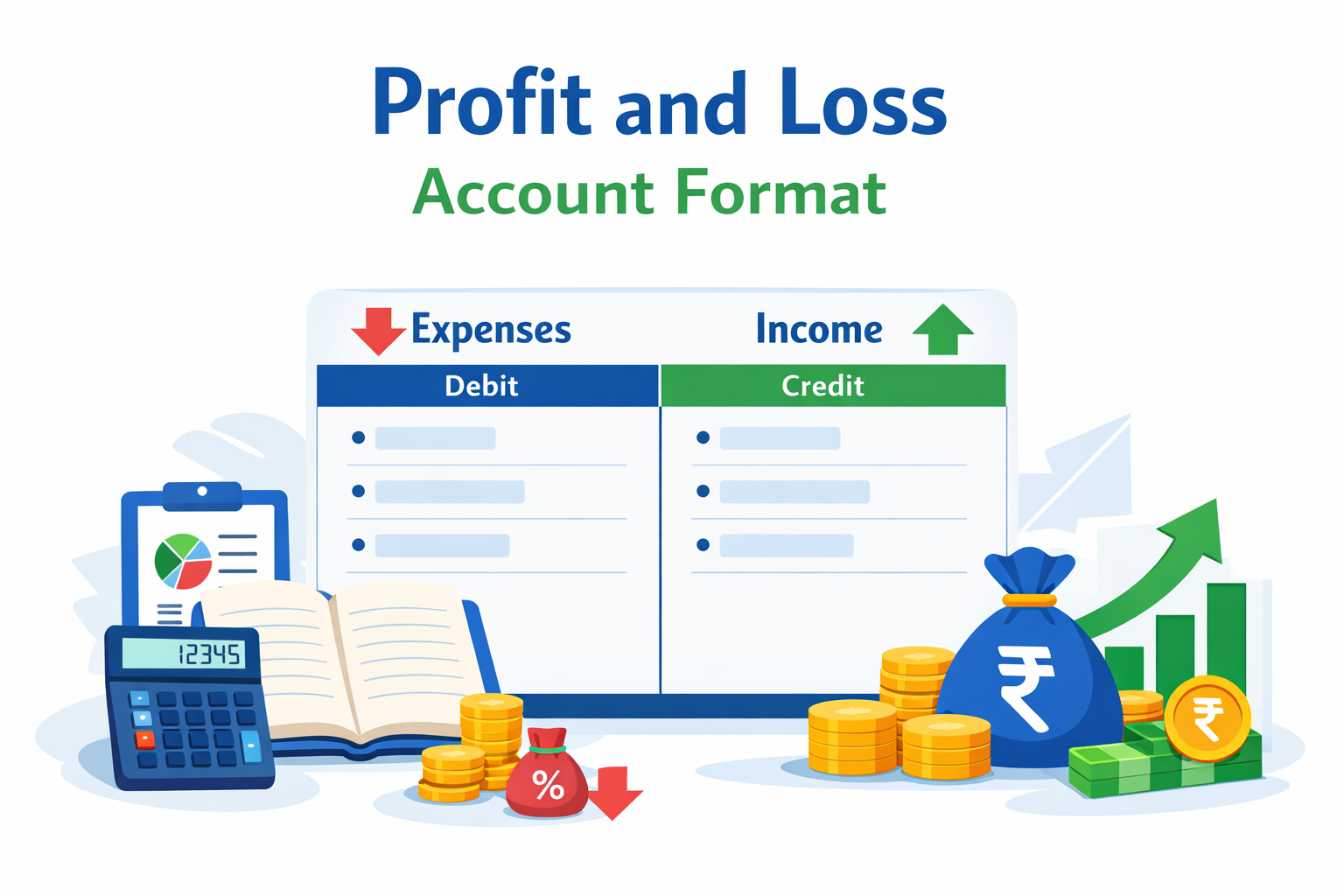
The traditional Profit and Loss Account Format is prepared in a T-shape, with:
-
Debit side → Expenses and losses
-
Credit side → Incomes and gains
Let’s understand both sides clearly.
Debit Side of Profit and Loss Account (Expenses & Losses)
The debit side records all expenses incurred to run the business and losses suffered during the accounting period.
Common items on the debit side include:
-
Cost of Goods Sold (COGS)
Opening stock + purchases – closing stock -
Operating Expenses
-
Salaries and wages
-
Rent
-
Electricity and water
-
Office expenses
-
Repairs and maintenance
-
-
Administrative Expenses
-
Legal charges
-
Audit fees
-
Printing and stationery
-
-
Selling and Distribution Expenses
-
Advertisement
-
Commission paid
-
Freight and carriage outward
-
-
Financial Expenses
-
Interest on loans
-
Bank charges
-
-
Depreciation
-
Reduction in value of assets like machinery or furniture
-
All these expenses reduce your profit, which is why they are recorded on the debit side.
Credit Side of Profit and Loss Account (Incomes & Gains)
The credit side records all incomes earned apart from the main business activity.
Common items on the credit side include:
-
Gross Profit
Transferred from the Trading Account -
Other Incomes
-
Interest received
-
Commission received
-
Discount received
-
Rent received
-
-
Profit on Sale of Assets
-
Profit on the sale of machinery or furniture
-
These incomes increase your profit, which is why they appear on the credit side.
Example of Profit and Loss Account Format
Here’s a simplified example to make things crystal clear:
Profit and Loss Account for the year ended 31st March 2026
Debit Side
-
Salaries – ₹50,000
-
Rent – ₹20,000
-
Electricity – ₹10,000
-
Advertisement – ₹15,000
-
Depreciation – ₹5,000
Total Expenses – ₹1,00,000
Credit Side
-
Gross Profit – ₹1,40,000
-
Interest Received – ₹10,000
Total Income – ₹1,50,000
Net Profit = ₹50,000
This net profit is transferred to the Capital Account or Balance Sheet.
Net Loss VS Net Profit
-
If total income > total expenses → Net Profit
-
If total expenses > total income → Net Loss
Net Profit increases the owner’s capital.
>Net Loss reduces the owner’s capital.
Modern (Vertical) Profit and Loss Account Format
In today’s digital accounting software, a vertical format is more commonly used.
Example:
-
Revenue
-
Less: Cost of Goods Sold
-
Gross Profit
-
Less: Operating Expenses
-
Operating Profit
-
Add: Other Income
-
Less: Interest & Tax
-
Net Profit
This format is easier to read and better for analysis.
Common Mistakes to Avoid in Profit and Loss Account
Many beginners make small but costly mistakes. Avoid these:
-
Mixing capital expenses with revenue expenses
-
Forgetting depreciation
-
Ignoring outstanding or prepaid expenses
-
Recording personal expenses as business expenses
Accuracy matters because even a small error can distort profit figures.
Who Should Understand the Profit and Loss Account Format?
-
Business owners
-
Startup founders
-
Commerce students
-
Accountants and finance professionals
-
Anyone planning to start a business
Even if you’re not from a finance background, understanding the Profit and Loss Account Format gives you control over your money.
Final Thoughts
The Profit and Loss Account Format is more than just numbers on paper—it’s the financial story of your business. It tells you where your money came from, where it went, and whether your efforts paid off.
Once you understand this format, you don’t just “run” a business—you manage it wisely.
If you master your P&L account, profits stop being a surprise and start becoming a strategy.
Must Read-: Personal Loan Using Aadhaar Card Eligibility and Verification Process
